
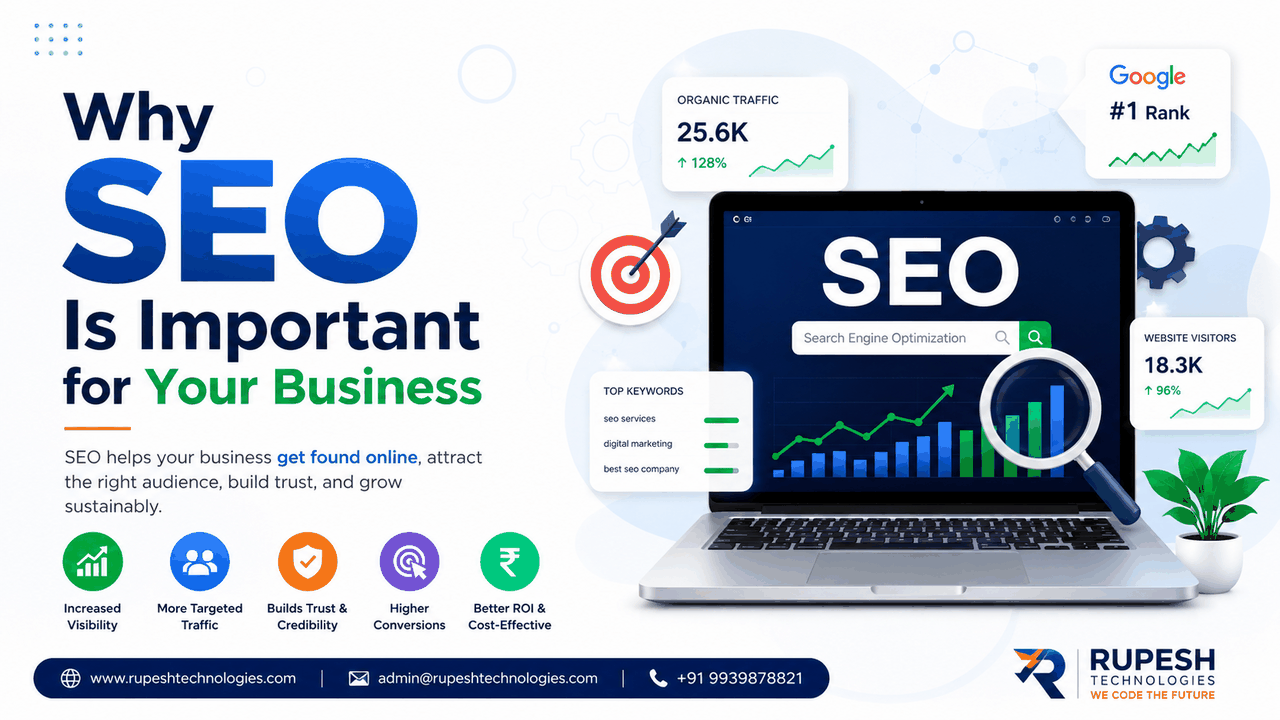
If you've ever built a website for your business and then wondered why it isn't bringing in customers, there's a good chance the answer lies in one word — SEO. You may have heard this term thrown around in marketing meetings, seen it mentioned by competitors, or had a developer casually say "you'll need to work on your SEO" without really explaining what that means or why it matters.
This guide is going to walk you through exactly what SEO is, why it's so important for any business with an online presence, and what actually happens when you invest — or don't invest — in it. No jargon, no confusing technical explanations. Just a clear, honest breakdown of why this matters for your business specifically.
Let's start from the very basics.
What is SEO, really?
SEO stands for Search Engine Optimization. In the simplest possible terms, it's the process of making your website easier for search engines like Google to understand, trust, and recommend to people who are searching for things related to your business.
Think about the last time you needed something — a plumber, a good restaurant, a laptop repair shop, a wedding photographer. What did you do? You almost certainly opened Google, typed a few words, and clicked on one of the first results that appeared. You probably didn't scroll to the second page. You probably didn't even look past the first three or four results.
That behavior — search, click, decide — happens billions of times every single day, across every industry imaginable. SEO is simply the practice of making sure that when someone searches for something your business offers, your website is one of the options they see first.
Why does ranking position matter so much?
Here's a statistic that surprises a lot of business owners the first time they hear it — the first result on a Google search page typically receives significantly more clicks than every other result on that page combined. By the time you get to the second page of search results, click-through rates drop dramatically, to the point where most users never even go there.
This means that if your website isn't showing up on the first page — or ideally, within the first few positions — for the searches that matter to your business, you're essentially invisible to a huge portion of your potential customers. It doesn't matter how beautiful your website looks or how great your products or services are if nobody ever finds it in the first place.
This is the core reason SEO matters so much — it's not about looking good, it's about being found.
Isn't paid advertising enough? Why do I need SEO too?
This is one of the most common questions business owners ask, and it's a fair one. If you can just pay for ads to show up at the top of Google, why bother with SEO at all?
The answer comes down to sustainability and trust. Let's break down both.
SEO builds a long-term asset. Ads don't.
When you run paid ads, you're essentially renting visibility. The moment you stop paying, your website disappears from that top position instantly. There's no lasting benefit once the budget runs out.
SEO works differently. When you invest in optimizing your website properly — improving content, technical structure, and building credibility — those improvements tend to stick around. A well-optimized page that ranks well organically can continue bringing in traffic for months or even years without any additional spending, unlike ads which require continuous investment to maintain visibility.
Users trust organic results more than ads
Most internet users have become naturally skeptical of paid advertisements. Many people specifically scroll past the "Sponsored" results at the top of a search page to find the organic listings below, because they intuitively feel that organic rankings represent genuine relevance and trust, rather than a business simply paying for placement.
This doesn't mean paid ads aren't valuable — they absolutely have their place, especially for quick visibility or promotions. But relying on ads alone, without any SEO strategy, means you're missing out on the audience segment that specifically trusts and seeks out organic results.
The smartest approach combines both
The most successful businesses typically don't choose one over the other — they use paid ads for immediate visibility and specific campaigns, while building SEO in parallel as a long-term foundation that continues delivering value well beyond any single campaign.
How does SEO actually bring in customers?
Let's get into the mechanics a little bit, because understanding this helps you see exactly why SEO deserves a place in your business strategy.
Step 1: Someone has a need
A potential customer realizes they need something — maybe their laptop just broke, maybe they're planning a wedding, maybe they're looking for a software company to build their CRM system.
Step 2: They search for it online
Instead of asking around or flipping through directories, they open Google and type something like "laptop repair near me" or "CRM software company in Jharkhand."
Step 3: Google shows them relevant results
Google's algorithm scans through millions of websites and decides which ones are most relevant, trustworthy, and useful for that exact search — then displays those in order.
Step 4: The user clicks on a result they trust
Naturally, they gravitate toward the results at the top, since Google has effectively already done the filtering work for them.
Step 5: They land on your website
If your website appears in that list — and looks credible, loads quickly, and answers their question clearly — you've just captured a potential customer at the exact moment they were looking for what you offer.
This is the fundamental power of SEO — it puts your business directly in front of people who are already actively looking for what you sell, at the precise moment they're looking for it. There's no other form of marketing quite like this, where the audience essentially raises their hand and says "I need this" before you even reach them.
What are the real, tangible benefits of investing in SEO?
Let's move beyond theory and look at the concrete benefits businesses experience when they take SEO seriously.
1. Increased website traffic
This is the most obvious benefit — better rankings mean more people finding and visiting your website. More traffic generally translates directly into more inquiries, more leads, and more sales.
2. Higher quality leads
Unlike some forms of advertising that cast a wide net, SEO traffic tends to be highly targeted. Someone who searches "buy office furniture in Ranchi" and clicks on your website is already interested in exactly what you're offering — they're not a random visitor, they're a qualified lead with genuine intent.
3. Increased brand credibility and trust
There's a subconscious trust factor at play when a business appears at the top of organic search results. Users tend to associate high rankings with authority and legitimacy, even if they can't quite articulate why. Being visible consistently for relevant searches builds this trust over time.
4. Better user experience
A big part of modern SEO involves improving your website's speed, mobile-friendliness, and overall usability. These same improvements that help your search rankings also directly improve the experience for every visitor, which in turn improves conversion rates — more visitors actually becoming customers.
5. A competitive advantage
If your competitors are investing in SEO and you're not, they're capturing the customers who should have been finding you. Conversely, if you invest in SEO while your competitors haven't, you gain a significant head start that can be difficult for them to catch up to later.
6. Long-term cost efficiency
While SEO does require an upfront investment of time and effort, the traffic it generates over time tends to cost significantly less per visitor compared to ongoing paid advertising, especially once your content and rankings mature.
7. Better insight into your customers
SEO work involves researching exactly what words and phrases your potential customers are searching for. This research alone often reveals valuable insights about what your audience actually wants, which can inform not just your website, but your broader business and product decisions.
What happens if you ignore SEO entirely?
It's worth being direct about this, because a lot of business owners don't realize the cost of inaction until it's already hurting them.
Your website becomes invisible
Without SEO, your website essentially exists in isolation. It might look great, but if it's not properly optimized, search engines struggle to understand what it's about, and as a result, it simply won't appear when potential customers search for related terms.
Your competitors capture your customers
Somewhere out there, your competitors are likely already working on their SEO — whether deliberately or simply because their website happens to be built in a search-friendly way. Every customer that should have found you but found them instead represents lost revenue.
You become entirely dependent on paid advertising
Without any organic visibility, your business becomes fully reliant on continuously paying for ads just to stay visible. The moment budgets get tight — which happens to every business at some point — your visibility disappears along with it.
You miss out on compounding growth
SEO tends to compound over time — the longer you consistently invest in it, the stronger and more resilient your rankings become. Businesses that delay starting their SEO efforts often find themselves years behind competitors who started early, making it significantly harder to catch up later.
What actually goes into SEO? A simple breakdown
SEO isn't one single activity — it's a combination of several different practices working together. Here's a simplified breakdown of the main areas.
1. On-page SEO
This involves optimizing individual pages on your website — things like using the right keywords naturally within your content, writing clear and descriptive page titles, structuring your content with proper headings, and ensuring each page clearly answers the questions your audience is asking.
2. Technical SEO
This is the behind-the-scenes work that makes your website easy for search engines to crawl and understand. It includes things like website speed, mobile responsiveness, proper site structure, secure connections (HTTPS), and making sure there are no technical errors blocking search engines from accessing your pages.
3. Content SEO
Search engines favor websites that consistently provide valuable, relevant content. This often means maintaining a blog or resource section where you regularly publish content that answers your audience's questions — which not only helps rankings but also positions your business as knowledgeable and trustworthy in your field.
4. Off-page SEO
This refers to actions taken outside your own website that influence your rankings — most notably, other reputable websites linking back to yours. These backlinks act as a signal of trust and authority in the eyes of search engines.
5. Local SEO
For businesses that serve a specific geographic area — like a clinic, a restaurant, or a local service provider — local SEO focuses on ranking well for location-based searches, and typically includes optimizing your Google Business Profile, gathering customer reviews, and ensuring consistent business information across the web.
How long does SEO take to show results?
This is one of the most important expectations to set correctly, because SEO is fundamentally different from paid advertising in terms of timeline.
Unlike ads, which can generate visibility within minutes of launching a campaign, SEO is a gradual process. Search engines need time to crawl your website, evaluate its relevance and trustworthiness, and adjust your rankings accordingly. Most businesses start seeing meaningful movement in their rankings within a few months of consistent effort, with more substantial results typically building over six months to a year.
This timeline often surprises business owners who expect instant results, and it's honestly one of the reasons some businesses give up on SEO too early — right before it would have started paying off. The businesses that see the biggest long-term rewards from SEO are the ones that treat it as an ongoing, patient investment rather than a quick fix.
Common SEO myths that hold businesses back
Let's clear up a few misconceptions that often prevent businesses from taking SEO seriously.
Myth 1: "SEO is a one-time task"
Many business owners believe that once their website is optimized, the work is done. In reality, SEO is an ongoing process — search engine algorithms evolve, competitors adjust their strategies, and your content needs to stay fresh and relevant to maintain and improve your rankings over time.
Myth 2: "I just need to stuff my pages with keywords"
Older SEO practices relied heavily on repeating keywords as many times as possible. Modern search engines are far more sophisticated and actually penalize this kind of unnatural keyword stuffing. Today's SEO focuses on genuinely useful, naturally written content that answers real user questions.
Myth 3: "SEO and social media are the same thing"
While both are valuable digital marketing activities, they work very differently. Social media helps build brand awareness and engagement with your existing audience, while SEO specifically helps new potential customers discover you through search engines when they have an active need.
Myth 4: "My business is too small to need SEO"
This is one of the most costly misconceptions. In fact, local and small businesses often see some of the fastest and most impactful results from SEO, precisely because there's usually less competition for local, specific searches compared to broad national keywords.
Myth 5: "I can just set it and forget it"
SEO requires consistent attention. Search engines regularly update their algorithms, and competitors are continuously working on their own optimization. Businesses that treat SEO as a set-it-and-forget-it task often see their rankings gradually decline over time as more actively managed competitors overtake them.
How do you know if your website needs SEO help?
Here are some clear signs that indicate it's time to invest in SEO.
- Your website rarely appears when you search for your own products or services on Google
- Most of your customers still find you through word-of-mouth or offline channels, not your website
- Your competitors consistently rank above you for relevant searches
- Your website gets very little organic traffic according to your analytics
- You've never actively worked on your website's SEO, and it was simply built without that consideration in mind
- Your website is slow to load or doesn't work well on mobile devices
If any of these sound familiar, there's likely significant untapped potential in your website that proper SEO work could unlock.
What should you look for in an SEO strategy?
If you're considering investing in SEO, here's what a genuinely effective approach typically includes.
A clear understanding of your target audience
Good SEO starts with understanding exactly who your customers are and what specific words and phrases they use when searching for businesses like yours.
A technically sound website foundation
No amount of content or keyword optimization can compensate for a website that's slow, poorly structured, or difficult for search engines to crawl properly.
Consistent, valuable content
Regularly publishing content that genuinely helps your audience — answering their common questions, addressing their concerns, showcasing your expertise — remains one of the most reliable ways to build long-term SEO strength.
Patience and consistency
As mentioned earlier, SEO is a long-term investment. A strategy that's applied consistently over months tends to significantly outperform sporadic bursts of effort followed by long periods of neglect.
Regular monitoring and adjustment
Since search engine algorithms and competitor strategies evolve constantly, an effective SEO approach involves regularly reviewing performance and adjusting the strategy accordingly, rather than a one-time setup that's never revisited.
How SEO impacts different stages of the customer journey
To really appreciate why SEO matters, it helps to look at how it influences a customer at every stage of their decision-making process, not just at the moment they finally make a purchase.
Awareness stage
At this stage, a potential customer might not even know your business exists yet — they're just aware they have a problem or a need. They might search something broad like "how to choose an ERP system for a small business" or "signs you need a new website." If your content shows up here, answering that early question helpfully, you've just introduced your brand to someone who wasn't specifically looking for you, but is exactly the kind of person who might need you soon.
Consideration stage
Now the customer knows what they need and is comparing options. Searches at this stage look more like "best CRM software for small business in India" or "web development company Jharkhand reviews." This is where strong SEO — combined with genuinely good content that showcases your expertise — can tip the decision in your favor, especially against competitors who haven't invested in this kind of visibility.
Decision stage
At this point, the customer is ready to choose. Searches become very specific — often including your brand name directly, like "Rupesh Technologies reviews" or "Rupesh Technologies pricing." Good SEO ensures that when someone searches specifically for your business, they find accurate, professional, trustworthy information — not an outdated website or, worse, nothing at all.
Post-purchase stage
Even after someone becomes a customer, SEO continues to matter. They might search for support articles, how-to guides, or troubleshooting help related to your product or service. A well-optimized support or resource section can reduce customer service load while also building loyalty and trust for future purchases or referrals.
Understanding this full journey makes it clear that SEO isn't just about capturing that final "ready to buy" search — it's about being present and helpful at every point where a potential customer might be forming an opinion about your business.
SEO and mobile users — why this matters more than ever
A significant majority of all search traffic today comes from mobile devices, not desktop computers. This has a few important implications for why SEO — specifically, mobile-friendly SEO — matters so much for modern businesses.
Search engines now evaluate websites primarily based on how well they perform on mobile devices, a practice often referred to as mobile-first indexing. This means that even if your website looks perfect on a desktop computer, poor mobile performance can significantly hurt your rankings across the board — not just for mobile searches, but for desktop searches too.
Beyond rankings, think about the practical reality — someone searching for "plumber near me" while standing in their kitchen with a leaking pipe is almost certainly doing that search on their phone, not opening a laptop. If your website is slow to load or difficult to navigate on a small screen, you risk losing that customer to a competitor whose website works smoothly on mobile, regardless of how good your actual service might be.
This is why modern SEO strategy places heavy emphasis on mobile responsiveness, fast loading times on mobile networks, and simple, thumb-friendly navigation — because search engines are simply reflecting what users actually need and expect.
The connection between SEO and business credibility offline too
It's worth mentioning a benefit of SEO that often gets overlooked — the impact it has on your business's credibility beyond just search engine rankings.
When a potential customer hears about your business — whether through word-of-mouth, a business card, or a social media post — one of the very first things many people do is search for your business name online to verify it's legitimate and see what others have to say. If your website doesn't appear prominently, or if it appears alongside outdated information, broken links, or poor reviews with no response, this can quietly damage trust even before a conversation begins.
A strong SEO presence — including an optimized website, positive reviews, and consistent business information across platforms — acts almost like a digital handshake, reassuring potential customers that your business is established, active, and trustworthy, even before they've spoken to anyone on your team.
SEO for different business models — is it always relevant?
A common question is whether SEO makes sense for every type of business, or only certain ones. Let's break this down honestly.
Service-based local businesses
For businesses like clinics, salons, repair shops, or consultants who serve a specific geographic area, local SEO is often one of the highest-return marketing investments available, since these searches typically have strong buying intent — someone searching "AC repair near me" usually needs help right now.
Ecommerce businesses
For online stores, SEO directly impacts product discoverability. Ranking well for specific product searches — rather than relying entirely on paid ads or marketplace platforms — can significantly reduce customer acquisition costs over time and build a more sustainable, independent sales channel.
B2B and service companies
Businesses selling services to other businesses — like software companies, agencies, or consultants — often benefit enormously from content-driven SEO, since B2B buyers frequently research extensively online before ever reaching out, comparing multiple providers based on the quality and depth of information they find.
Educational institutions and training centers
Parents and students very commonly search online before enrolling anywhere. Ranking well for relevant local searches, along with maintaining a helpful, informative website, can significantly influence enrollment decisions.
Across virtually every business model, the common thread is this — if there's any chance a potential customer might search for something related to what you offer, SEO has direct relevance to your growth.
Working with an SEO partner — what to expect and watch for
If you decide to work with an agency or freelancer for your SEO, here are a few practical things worth keeping in mind to ensure you're getting genuine value.
Be wary of guaranteed rankings
No legitimate SEO provider can guarantee a specific ranking position, since search engine algorithms are complex and constantly evolving, and rankings depend on many factors outside anyone's complete control. Be cautious of anyone promising guaranteed "number one" rankings — this is often a red flag for questionable practices that could harm your website in the long run.
Ask for regular, understandable reporting
A good SEO partner should be able to clearly show you what work has been done, what improvements have resulted, and how that connects to actual business outcomes — not just technical jargon and confusing charts.
Understand that SEO requires ongoing collaboration
Especially around content, your SEO partner will often need input from you — your industry expertise, common customer questions, and business updates — to create genuinely valuable content. The best results usually come from an ongoing collaborative relationship, not a one-time handoff.
Set realistic expectations from the start
A trustworthy SEO partner will be upfront about realistic timelines and honest about what's achievable given your industry's competitiveness, rather than making unrealistic promises just to win your business.
Getting started — a simple first-step checklist
If everything so far has convinced you that SEO deserves attention, but you're not sure where to actually begin, here's a simple starting checklist that applies to almost any business.
1. Search for your own business and your main services
Start by simply googling your business name, and then a few key services or products you offer combined with your city or area. See where you currently show up, if at all. This gives you an honest starting point.
2. Check your website's mobile experience
Open your website on your own phone and genuinely try to use it as a customer would. Is it fast? Is it easy to navigate? Can you find contact information within a few seconds?
3. List the questions your customers ask most often
Think about the common questions customers ask before buying from you, whether over the phone, in person, or through WhatsApp. These questions are often exactly what people are typing into Google too — and answering them clearly on your website is one of the simplest, most effective starting points for content.
4. Set up and complete your Google Business Profile
If you serve customers locally, claiming and fully completing your free Google Business Profile — with accurate hours, photos, and a clear description — is one of the highest-impact, lowest-effort steps you can take immediately.
5. Commit to consistency over perfection
You don't need a perfect strategy from day one. What matters far more is consistently showing up — whether that's regularly updating your website, responding to reviews, or publishing helpful content — over an extended period of time.
Starting with these simple, practical steps builds a genuine foundation, even before bringing in more advanced strategy or professional help.
How SEO compares to other marketing channels businesses commonly use
To put SEO's role in full perspective, it helps to briefly compare it against other common marketing channels businesses invest in.
Compared to social media marketing — social platforms are excellent for building brand personality and engaging with an existing audience, but they rely heavily on people already following or discovering your page. SEO, by contrast, captures people actively searching with intent, often without any prior awareness of your brand.
Compared to print or traditional advertising — traditional ads reach a broad audience regardless of interest, and results are difficult to measure precisely. SEO reaches specifically interested people and provides clear, measurable data on traffic, rankings, and conversions.
Compared to referrals and word-of-mouth — referrals are valuable but limited by the size of your existing network. SEO extends your reach to anyone searching online, regardless of whether they know someone who's used your business before.
None of this means other channels aren't valuable — a well-rounded marketing strategy typically uses several channels together. But SEO holds a unique position because it captures demand that already exists, rather than trying to create interest from scratch.
Frequently asked questions
1. Is SEO only important for big companies?
Not at all. In fact, small and local businesses often benefit the most from SEO, since they're typically competing for more specific, less competitive searches where good optimization can make a significant, faster impact.
2. Can I do SEO myself, or do I need to hire someone?
Basic SEO practices can certainly be learned and applied by business owners themselves, especially for smaller websites. However, more advanced technical SEO, competitive strategy, and consistent execution over time often benefit from professional expertise, particularly for businesses serious about long-term growth.
3. How much does SEO typically cost?
SEO costs vary significantly based on your industry, competition level, and the scope of work required. Rather than a fixed price, it's best understood as an ongoing investment, with costs typically scaling based on how competitive your market is and how aggressively you want to grow.
4. Does SEO work the same way for every industry?
The core principles remain consistent, but the specific strategy — which keywords matter, how competitive the space is, what type of content resonates — varies significantly across industries. A strategy for a local restaurant looks quite different from one for a software company.
5. What's the difference between SEO and SEM?
SEO (Search Engine Optimization) focuses on improving organic, unpaid rankings. SEM (Search Engine Marketing) is a broader term that includes both SEO and paid advertising strategies like Google Ads. Many businesses use both together for maximum visibility.
6. Will SEO results last forever once achieved?
Not automatically. Rankings can decline over time if a website isn't maintained, if competitors improve their own SEO, or if search engine algorithms change. Ongoing effort is generally required to maintain strong rankings over the long term.
7. Can a brand new website compete with established competitors through SEO?
Yes, though it typically takes more time and consistent effort, since established websites often have accumulated trust and authority over years. Focusing on specific, less competitive keywords initially — often called long-tail keywords — is a common strategy for newer websites to start gaining traction.
8. Does having a blog actually help SEO?
Yes, significantly. A well-maintained blog gives search engines fresh, relevant content to index regularly, and provides more opportunities to rank for a wider range of search terms related to your business and industry.
9. How do I measure whether my SEO efforts are working?
Key indicators include improvements in your search rankings for target keywords, increased organic website traffic over time, more inquiries or leads coming through your website, and improved visibility for searches specifically related to your business and location.
10. Is it too late to start SEO if I've never done it before?
It's never too late to start. While earlier investment does provide a head start, businesses beginning their SEO journey today can still build strong, sustainable visibility over time — the key is starting consistently rather than waiting for a "perfect" moment.
Final thoughts
SEO isn't a technical afterthought or an optional add-on to your website — it's one of the most fundamental factors determining whether your business gets found by the customers who are actively looking for what you offer. In a world where the vast majority of buying decisions begin with a Google search, being invisible in search results essentially means being invisible to a huge portion of your potential customer base.
The businesses that treat SEO as a genuine, ongoing priority — rather than a one-time task or an afterthought — tend to build lasting, compounding visibility that continues delivering value long after the initial work is done. It requires patience and consistency, but the businesses that stick with it consistently outperform those that don't in the long run.
At Rupesh Technologies, we help businesses across Jharkhand and Bihar build websites that aren't just visually appealing, but properly optimized to actually get found by the right customers. Whether you're starting from scratch or looking to improve your existing website's performance in search results, we're happy to have a conversation about where your website currently stands and what genuine opportunities exist for growth.
Reach out to us at admin@rupeshtechnologies.com and let's talk about building an SEO strategy that actually brings customers to your business.